
Alas, Scott Adams
AstralCodexTen memorializes a fellow of infinite jest.

Scott Alexander at the AstralCodexTen blog memorializes the late cartoonist Scott Adams in one long, funny essay (and one follow-up post) that was apparently not appreicated by everyone in that it failed to eulogize Adams, presenting him as a man of parts, created by the interaction of his strengths and weaknesses. Short a real biography, Alexander’s is probably about as good a memorializing essay on Scott Adams as one is going to find. It’s too long and not hagiographic enough for an obituary, but written by a fan of his humor trying to understand him rather than an enemy. I don’t know that I agree at every point however.
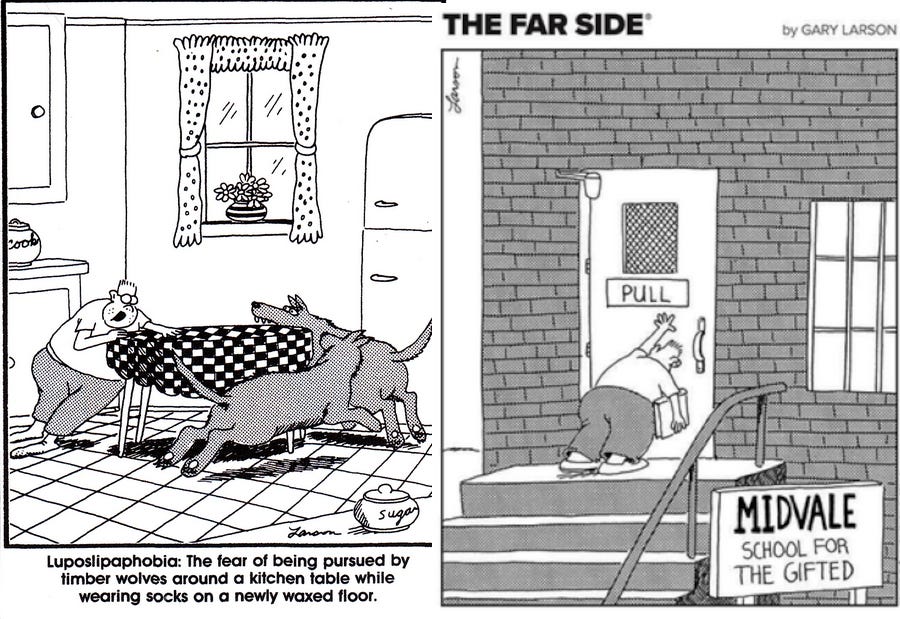
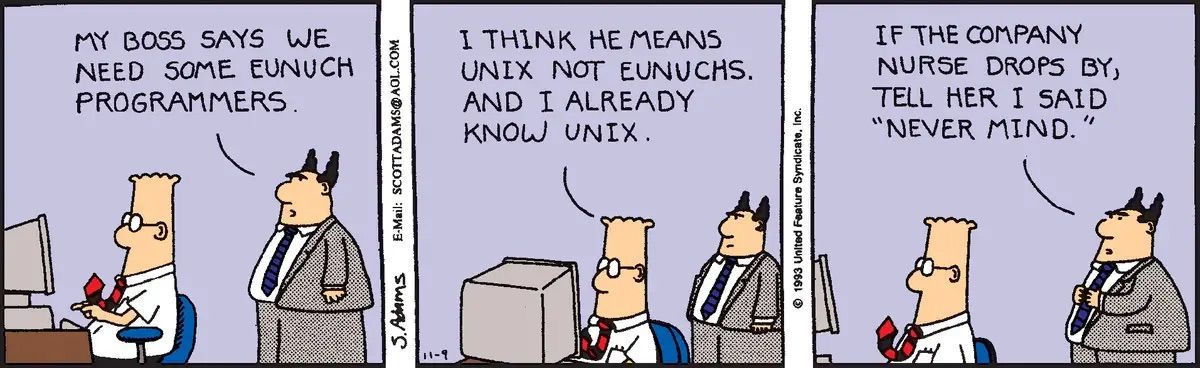
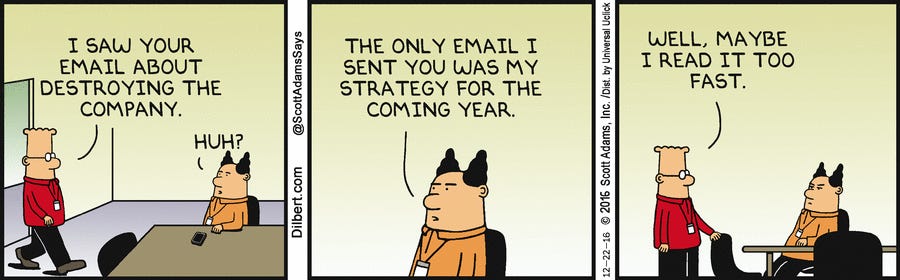
Personally, I was not a regular follower of Scott Adams. Unlike Alexander, I did not read all the Dilbert collections. In fact, when I first came across Dilbert, I didn’t think it was very funny. And while I can see that Scott Adams was a jovial and fun joker, I still don’t care much about Dilbert. The really funny strips are maybe only one of every ten, and the mildly amusing ones only six or seven of every ten. Unlike The Far Side, which was often based on translating slapstick humor into single-panel static illustrations (a male clown prepares to throw a pie in the face of a female clown, and she: “Not on the first date, you don’t!”) or based on whimsical use of language (”Luposlipophobia”), Dilbert was often a dunk on someone that depended on the same type of humor one would find in an office space. I don’t mean the topics were about office life, but the actual humor was of the kind one might hear from co-workers, with humorous in-group allusions and rather flat punch lines. A lot of times, the joke was actually in the second panel. “If the company nurse drops by, tell her I said ‘never mind’” is a pretty weak third panel when the first panel introduces the idea of “eunuch programmmers” and the second panel conflates “eunuchs” and “Unix”. Alexander says the humor is about nerds. I suppose he’s right, although I think The Far Side’s famous nerd trying to enter a school for the gifted is essentially a Dilbert strip with a proper punch line and shows what Dilbert should have been.
I was first exposed to the character of Scott Adams the man in 2015. I was living by myself in a one-room apartment up on a forrested, slightly remote hilltop where the trees and undergrowth came right up to the ground-level veranda where I kept my washing machine. I used to listen to Tim Ferriss podcasts when I was puttering around, and I remember listening to the Scott Adams interview on a warm autumn day while doing laundry with the door to the veranda open. It made enough of an impression on me for me to remember it. Of course, in post-Trump elections 2026, all that stuff about hypnotism and persuasion and affirmations and living in a simulation seems like old hat, but in autumn 2015, it was like listening to a guy in a tin-foil hat show you that there really are radio waves controlling your thoughts.
Alexander covers most of the tin foil hat stuff in his essays, psychoanalyzing Scott Adams into wanting to manipulate people with hypnotism in order to compensate for his lack of other skills and lack of natural Alpha magnetism. Specifically, Alexander says what Scott Adams really wanted was to be Dogbert: “Dogbert is clearly Sociopath... his character was a ridiculous scammer who succeeded at near-impossible endeavours (like convincing people he was a Nostradamus-style mystical prophet)... This is making me somewhat regret accusing Adams of wanting to be the Pointy-Haired Boss. It would have been fairer... to accuse him of wanting to be Dogbert.” And I think he’s right. Check out this from the Tim Ferriss interview @1:21:38:
ADAMS: Well, in the beginning, their characters are, um, not really formed, so, you know, you’ve got an idea who they are, and maybe you’re thinking of somebody else when you write it. But over time they become, um, some part of me, you know, they’re--they each represent a different voice of my head. You know, Dilbert’s kind of the voice of reason, and, you know, the one that, you know, is, uh, let’s say he’s challenged by, you know, he loves a, a challenge. He likes fixing things more than he likes, you know, talking to people and social interactions and stuff. Dogbert is the, the evil part of my brain: the, the little voice in my head that is saying just the worst things when I’m in an otherwise polite conversation, and, you know, it’s the, it’s the voice that’s trying to keep me from not laughing or, or forcing me to tell a bad joke suddenly so I have a reason to laugh at it myself—really covering up that I’m thinking something horrible. Uh--so yeah, he’s, he’s the worst part of me--you know, my megalomania and my, you know, my lack of regard for other humans, which I--you know, obviously it’s an exaggeration--I’ve, I have plenty of regard for other humans, but not always their intelligence. So, Dogbert takes that role.
My only personal interaction with Scott Adams was about tin foil hat stuff. I was never really able to understand his point about persuasion, about what persuasion was. I understand the idea that when Trump made fun of Rosy O’Donnell in that first election, he totally took control of the narrative about his attitude towards women, but what is persuasion, exactly? During the 2016 election, I had a (now defunct) Twitter account. At one point, Scott Adams asked people to submit examples of persuasion that could be used against Hillary. I made an image of her “I’m with Her” logo, but replaced the H’s with the Twin Towers and the arrow with an airplane. I thought the idea would be “persuasive” in the sense of making people associate Hillary’s logo with the negative and easy to remember image of the Twin Towers attacks. The subtext was “electing Hillary will be a disaster like the WTC attacks,” but Scott Adams didn’t like it. I forget exactly what he responded but it was something along the lines of “no, this isn’t an example of being persuasive at all.”
So, I don’t understand persuasion at all, but I think Alexander gets something wrong about it in his essays. Saying that persuasion is not all that, he writes, “Even Donald Trump has only a 37% approval rating, because he can’t make ‘we should alienate our allies over Greenland’ sound plausible to most of the American people.” In this case, I think the object of persuasion is important. Alexander references a pick-up artist who can persuade a girl to sleep with him, but we know that, as third-party observers to that situation, we can often see what the girl cannot. Is Trump trying to convince the American people about Greenland, or is the object of his negotiations European leaders, while the American people are just third-party observers? I see from today’s newsfeed that NATO’s Mark Rutte is agreeing with Trump about Arctic security.
Alexander highlights Scott Adams’ history of failed predictions. As far as I knew, he mostly had gotten COVID wrong, but so had Curtis Yarvin, another Californian. Somehow, I was never surprised that Californians got COVID wrong. But Alexander focuses mostly on political predictions, and I’m not sure how fair he is. He makes much, both in his original essay and in the follow-up post, about a July 1, 2020, Tweet from @ScottAdamsSays: “If Biden is elected, there’s a good chance you will be dead in a year,” followed up immediately by “Republicans will be hunted.” A commenter named Joel Pollack criticizes Alexander for claiming that this is a failed prediction, and Alexander responds in part:
Also, when I was replying to Joel Pollak about this, I happened to glance at his Twitter account, and one of the top tweets was a repost of someone saying that “The Democrat playbook is to arrest every single person who disagrees with them”. I think if I forced Pollak into some kind of extremely literal frame of mind - maybe asked him to bet money on whether I could tweet the words “the Democrats are wrong about immigration” in my Democrat-controlled state without getting arrested - he would admit that, okay, they don’t want to arrest literally every single person who disagrees with them. He was exaggerating for effect, probably in much the way he’s going to say that Scott Adams was exaggerating for effect. You say stuff like “The Democrats are going to HUNT YOU DOWN and LITERALLY MURDER YOU. They will TORTURE YOUR FAMILY and RAPE YOUR DAUGHTER and EAT YOUR PETS and TURN YOUR HOUSE INTO A CHURCH OF SATAN”, and what you mean is “I disagree with the Democrats and sometimes they go overboard cancelling people”.
I guess Alexander’s point is that ridiculous exaggeration is unwarranted nose-holding fare. However, “the Democrat playbook is to arrest every single person who disagrees with them” is not really on par with screaming “They will TORTURE YOUR FAMILY and RAPE YOUR DAUGHTER and EAT YOUR PETS.” Beyond all the unjustified lawfare of the last few years, here’s an exhibit from just today’s newsfeed, which reports Democrats saying that the mid-term election...
...means that Congress is going to haul Elon Musk, ‘Big Balls,’ and a bunch of other people’s ass in front and say, ‘What crimes did you commit?’ And it’s going to get really serious... And the same with Trump because I believe, and this is just my opinion, that Trump and all of the bottom-feeding morons surrounding him and Elon Musk and all the bottom feeding clinger-onners that surround him, I think they commit crimes every day... And I think to reconcile all of this is going to take hardcore — not “integrity Democrats”, “Fuck you Democrats”... “Fuck you for fucking over our country.” We are serious about this. We are prosecuting. We’re going to uncover every document, every phone call, everything you did. We will be relentless about it.
Obviously, when Pollack says “every single person”, that’s hyperbole. However, it’s not on par with exaggerating the actions the Democrats are going to take. They won’t arrest “every single person” but they intend to arrest a lot of people if they can. Similarly, I have co-workers who are leftists and don’t know my politics, and they regularly speak about either killing Republicans or throwing them in concentration camps or censoring their speech or preventing them from electing their party. “Republicans will be hunted” didn’t happen yet, but it does represent the mindset of many of the people Scott Adams was talking about. Was it a failed prediction? What’s your timeline?

The main point on which I think Alexander is wrong, however, is ivermectin to treat cancer. Ivermectin is not “right wing,” but more importantly Scott Adams was a medical skeptic long before he was a Trump supporter. The proof is one episode of life that was captured in the Tim Ferriss interview but that I have not seen referenced in other places. At some point in his past, Scott Adams lost the use of his vocal chords. He couldn’t speak properly due to a condition called spasmodic dysphonia. By going to a surgeon who performed a procedure on him that was not supported by the medical establishment, he was able to recover his voice. He reports @1:41:02:
ADAMS: ...Um, what’s interesting about that is nobody knows why that works because the problem has been well identified to be a little brain hiccup. So you don’t—you don’t fix your brain by rewiring the nerves in your neck. Now, hold that thought—nobody knows why the surgery works. Now, the only other thing that works for this that I’ve personally, uh, verified ‘cause I’ve talked to the individuals who’ve done this—and I actually went through this training myself—was a doctor who some thought was a—was a nut because science was not quite supporting his method, but he would go in, and he would say, “Everybody hum at the key of F for weeks, and try to never talk at your natural deeper tone—instead of just hum.” Now, I think it might have worked for 10 or 20% of the people—but keep in mind this is an incurable problem, right? That 10 to 20% of the people walked out with perfect voices. I—I spoke to, uh, one of them—actually several of them—I spoke to live—so I verified, and one of them crossed over my week, so I know it’s a real person—not a shill or something. Now, what do these two things—the surgery, which nobody knows why it works, and the humming in the key of F, which nobody knows why it works....
ADAMS: But listen to this—the um, it gets more interesting because this is more validation for why this might work. This doctor could get no credibility because when he would report his cures—which he was shouting at the top of his voice, he was making videos showing the people—showing the actual people talking before and after—it was as convincing as it possibly could be. And when he would take it to the medical community, they would say...
So, as you can see, Scott Adams was always--from years before Trump came down the escalator or the Kung Flu came from Wuhan--on the side of medical woo-woo and experimentalism and maybe doctors don’t know what’s best. It actually makes total sense since he didn’t believe in reality. As far as his cancer was concerned, he tried every treatment he could. At the point at which he was considering assisted suicide, he learned of a treatment that would let him keep going for a while, and he did it while, he reported, asking President Trump to allow to also take experimental, non-FDA-approved drugs. Adams’s use of ivermectin is a clear example of how Alexander’s medical bubble and left coast bubble have acted as two lenses that have distorted his view. If he were outside those bubbles, he would recognize that neither Scott Adams nor ivermectin are right wing and that his use of ivermectin came out of a different part of his psychology.
Well, that wraps it up for me. After listening to that Tim Ferriss interview all those years ago, I emailed it to my dad, as he also likes cartooning (the production of it, not just the laughs). After he became an Ever Trumper, he got much more interested in Scott Adams than I ever was, and over the years Real Coffee with Scott Adams provided lots of topics of conversation for us. I feel sorry for my dad, and I’ll miss the anecdotes that he reported about Real Coffee. His last one was letting me know about Scott Adams’ farewell message, read to his listeners by his ex-wife. Alas, Scott Adams. Requiescat in Pace.